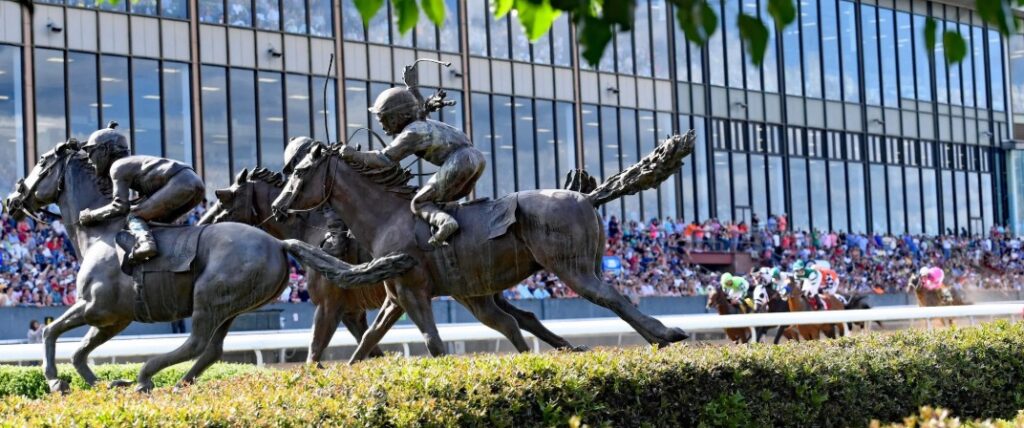
The Arkansas Derby: Oaklawn’s Penultimate Race with a place in the Kentucky Derby At Stake.
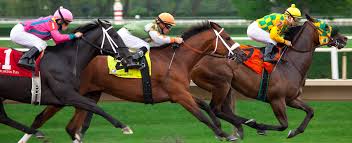
As the spring sun ascends over Hot Springs, Arkansas, a palpable energy envelops Oaklawn Park. Today, the 90th running of the Arkansas Derby, a race that has evolved from a local fixture into a quest for entry into the Kentucky Derby. For horse racing enthusiasts and bettors alike, this Grade I, $1.5 million contest is a thrilling spectacle of speed and stamina garnering attention from fans across the globe.
Legacy of Oaklawn Park
Oaklawn Park’s history is as rich and textured. Founded in 1904 by a group of local businessmen and former thoroughbred owners, the track opened for its inaugural meet on February 24, 1905, with a modest crowd of 3,000 spectators witnessing six races. The vision was simple yet ambitious: create a premier racing destination in the natural spa city of Hot Springs, leveraging the built in tourism from the area’s reputation for healing waters and relaxation.
The track’s early years were marked by both triumph and tribulation. Oaklawn faced financial challenges and the existential threat of anti-gambling legislation that swept the nation in the early 20th century. The track managed to operate intermittently through these turbulent times, demonstrating a resilience that would become its hallmark. It wasn’t until 1934, following the repeal of prohibition and the legalization of pari-mutuel wagering in Arkansas, that Oaklawn began its transformation into the racing institution we know today.
The modern era of Oaklawn truly began in 1962 with the arrival of Charles Cella, whose family had purchased the track two decades earlier. With Cella’s leadership, Oaklawn underwent significant improvements and began cultivating its current reputation for innovation and excellence. He understood that to compete with the powerhouse tracks of New York and Kentucky, Oaklawn needed to offer something distinctive. The creation of a lucrative winter-spring races that would attract the nation’s finest three year olds.
Cella’s elevating the Arkansas Derby to national prominence was the key. He increased the purse and scheduling the race weeks before the Derby. This created a substantial draw for horses seeking a final, serious prep and entry into the crown jewel, The Kentucky Derby. The plan worked. Over the decades, the Arkansas Derby has hosted racing royalty, including Hall of Famers like Sunny’s Halo (1983), Smarty Jones (2004), Afleet Alex (2005), Curlin (2007), American Pharoah (2015), and Sandman (2025). All those horses used Oaklawn as their launching pad to the Kentucky Derby.
Today, Oaklawn is a testament to its founder’s vision and Cella’s stewardship. The track has maintained its historic charm while embracing modern amenities, creating an atmosphere that feels both timeless and contemporary. Its racing surface is widely regarded as one of the fairest and safest in the country, producing consistently fast times and thrilling finishes. For racing purists, a day at Oaklawn represents a return to the sport’s core values of quality competition, passionate fans, and an unwavering respect for thoroughbred traditions.
The Arkansas Derby: A Kentucky Derby Proving Ground
The Arkansas Derby’s ascent from a local stakes race to a Kentucky Derby prep is a story of strategic vision combined with equine excellence. First run in 1936, the race initially carried little significance beyond its region. As Oaklawn’s reputation grew, so too did the quality of horses contesting its signature event.
In the 1970s, Oaklawn began aggressively marketing the race to owners and trainers of top-tier three-year-olds. The introduction of the “Racing Festival of the South” in the 1980s further elevated it’s profile. Filling out the day with a full card of high-quality stakes races, it gained national attention.
Awarded a Grade I status in 2010, formal recognition of what racing insiders had known for years about the Arkansas Derby. It consistently attracts elite talent and produces Kentucky Derby contenders. Its position on the calendar, (late enough for horses to have sufficient foundation but early enough to allow recovery time before the first Saturday in May) makes it an ideal final prep. The 1 1/8-mile distance provides a stern test of stamina without being overly taxing. The track’s typically fast conditions often produces timing that catches the attention of handicappers nationwide.
The race has also evolved in terms of its qualifying points for the Kentucky Derby. As part of the Road to the Kentucky Derby series, the Arkansas Derby now offers 100-50-25-15-10 points to the top five finishers, essentially guaranteeing the winner a spot in the starting gate at Churchill Downs and providing a significant advantage to those who finish in the top four. This attracts an even stronger field in recent years for horses need a few more points to make the cut.
The list of Arkansas Derby winners who went on to Kentucky Derby glory is impressive. Sunny’s Halo became the first to accomplish the double in 1983, followed by Grindstone in 1996, Smarty Jones in 2004, and most famously, American Pharoah in 2015. The latter’s victory at Oaklawn was particularly memorable, as he delivered a dominant performance that hinted at the greatness to come in his eventual Triple Crown campaign.
Analyzing the 2026 Arkansas Derby
The Arkansas Derby once again finds itself at the center of the Kentucky Derby conversation. With 100 qualification points on offer and a $1.5 million purse attracting the nation’s leading sophomore talent, today’s race shapes as one of the most competitive editions in recent memory.
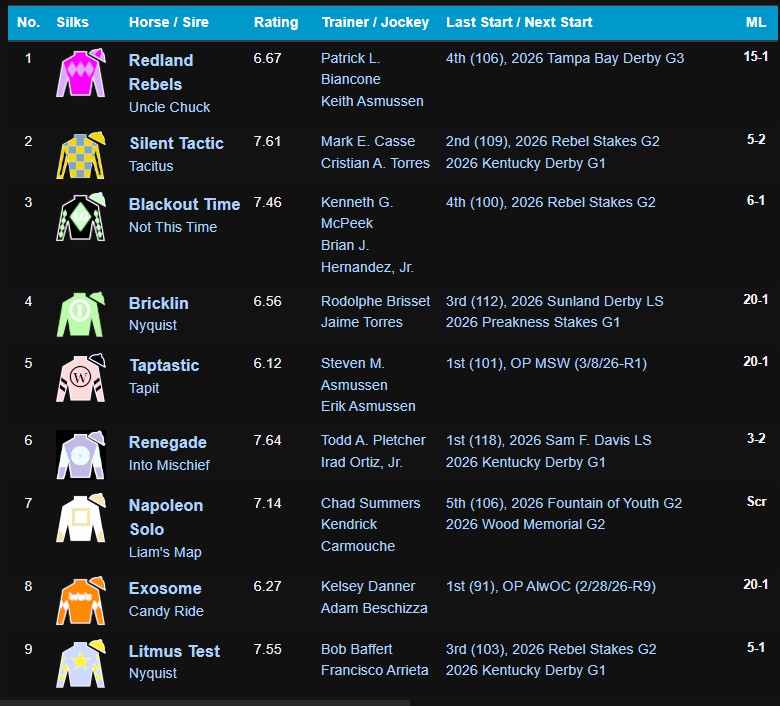
The 2026 Arkansas Derby features a compact but competitive field of nine horses, with a clear favorite emerging at the top of the morning line. The Todd Pletcher-trained Renegade, a $975,000 purchase with a consistent record of one win, two seconds, and a third in four career starts, is the 3-2 morning-line favorite and is poised to become a major contender for the Kentucky Derby with a victory. The main challenge is expected to come from Silent Tactic at 5-2, with the Bob Baffert-trained Litmus Test just behind. The rest of the field is led by Blackout Time at 6-1, followed by longer shots in Redland Rebels (15-1), Bricklln (20-1), Taptastic (20-1), and Exosome (20-1), creating a race that appears to have a defined top tier but also offers potential value for those looking deeper into the betting pool for your exotic bets.
Leave a Reply